


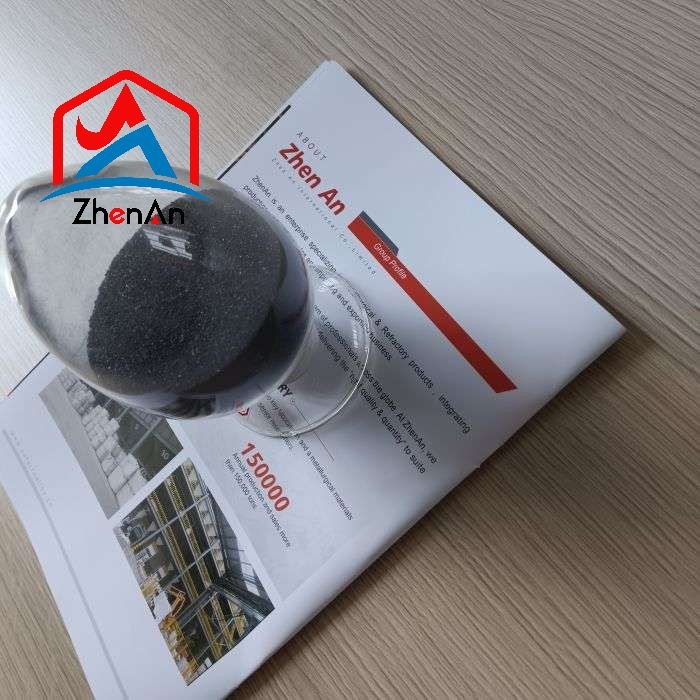

Silicon Carbide SIC98
►Green silicon carbide thermal conductivity-Good in thermal conductivity.
Beschreibung
The content of natural silicon carbide and moissanite (also known as moissanite) is very small. Silicon carbide used in industry is a synthetic material commonly known as emery. In 1891, American scientist Acheson accidentally discovered carbide in an experiment on fused diamond. At that time, he mistakenly thought it was a mixture of diamonds, so he named it emery.
In the same year, Acheson studied methods for industrial smelting of silicon carbide. It is also commonly known as the Acheson furnace and is still in use today. It is a resistance furnace that uses carbonaceous material as the furnace core and electrically heats the mixture of quartz SiO2 and carbon to generate silicon carbide SIC98.
| 60# | F.C | Fe2O3 | ||
| 65# | 60min | 15-20 | 8-12 | 3.5max |
| 70# | 65min | 15-20 | 8-12 | 3.5max |
| 75# | 70min | 15-20 | 8-12 | 3.5max |
| 80# | 75min | 15-20 | 8-12 | 3.5max |
| 85# | 80min | 3-6 | 3.5max | |
| 90# | 85min | 2.5max | 3.5max | |
| 95# | 90min | 1.0max | 1.2max | |
| 97# | 95min | 0.6max | 1.2max | |


In addition to the main component SiC, industrially produced silicon carbide SIC98 sand usually contains impurities. These impurities mainly include:
(1) Free silicon. Part of it is dissolved in the SiC crystal, and part of it forms an alloy with its impurities (such as iron, aluminum, calcium, etc.) and adheres to the crystal or is embedded in the crystal.
(2) Free silica. Usually found on crystal surfaces. Most of them are caused by the contact oxidation of SiC with oxygen or water vapor in the air during the cooling process of the resistance furnace. When there is an excess of silicon raw material in the ingredients, it will also evaporate and condense on the surface of the silicon carbide crystal, and white and fluffy SiO2 may appear in the furnace.
(3) Carbon. Part of the carbon is wrapped in the SiC crystal, and part of it forms carbides with metal impurities. When there is too much carbon in the ingredients, visible free carbon particles can be seen.
(4) Iron, aluminum, calcium, magnesium, etc. Due to the high-temperature reducing atmosphere in the furnace, most of these impurities contained in the crystal ingot are in the alloy state or carbide state. Impurities such as iron, magnesium, and calcium do not enter the crystal lattice but accumulate at grain boundaries and pores. The main impurities entering the SiC lattice are nitrogen, aluminum and aluminum, which have an important impact on the conductive properties of the crystal.
Beliebte label: silicon carbide sic98
Anfrage senden
Das könnte dir auch gefallen


